

See Early Photos of The Five Corners Historic District
The Store at Five Corners is a living museum, with an ongoing exhibit of photos, documents and maps of the Store and its surrounding Five Corners Historic District. This neighborhood has long been recognized on the National Register of Historic Places for its historic significance.
The Store itself was initially known as Sloan’s Tavern (visited by George Washington) next as The Sabin House inn, and later as a town meeting house, post office, and general store known as Steele’s Store.
On the Store’s enclosed porch, an entire wall is filled with photos of the Store, the nearby Idlewild Hotel (previously a boys’ boarding school), a one-room schoolhouse, a church, shops, and houses dating back to the 1760s. While enjoying refreshments, visitors can easily envision how this neighborhood once looked, surrounded by historic buildings.
Also look for the 3-ring notebooks with a detailed history of the Store, letters dated 1869-71 from a student named Willie, press clippings, an 1898 Idlewild brochure describing resort amenities including rooms with best hair mattresses and a casino, and postcards dated 1909-15.
Fun Facts about The Store at Five Corners
- The Store has been in nearly continuous operation for over 257 years! It has been known as “Sloan’s Tavern”, “Sabin House Inn” and “Steele’s Store”.
- George Washington was reported to have stopped at Sloan’s Tavern on August 30, 1790: “President George Washington, accompanied by Congressman William Smith, mounted on horseback, rode from Lebanon Springs, NY, to Bennington, VT to consult with Governor Moses Robinson about Vermont’s final admittance into the Union. They breakfasted at General Samuel Sloan’s Tavern.” (From “The Hoosac Valley, Its Legends and Its History” by Grace Greylock Niles).
- Samuel Sloan eventually sold his tavern after serving in the Revolutionary War and built a new home in town, currently the residence of the President of Williams College on Main Street.
- You can see original posts from when The Store was built (1770) at the wall in front of the kitchen.
- We can tell an extra 10 feet were added on to the back of The Store after the 18th century because of the type of the wood used for the addition (second growth chestnut).
- As the Store’s footprint evolved over the years, parts of the building were recycled into use for renovation and repairs. There are posts in the main area of The Store that are not structural supports, only decorative. In fact, three of them are installed upside down! (Can you find them?)
- In the early 1900s the building was moved back from the road to its current position by jacking it up and placing logs under it. 25 teams of horses were hitched up in tandem and the building was rolled on the logs and placed over a pre-dug cellar. All of this was achieved in three days by neighbors and other volunteers.
- The Store was the hub of the South Williamstown community and served as a post office as well. Jane Steele was the first Postmistress in the United States, serving from 1915 until her death in the 1930s.
- There used to be a hot dog stand and an ice cream stand in front of The Store, as well as gas pumps.
- In 1978, The Store was in danger of being torn down with the prospect of a fast food franchise taking ownership. At that time The Store was purchased by William Vanderbilt (former Governor of Rhode Island) and his wife, Helen, and it was renamed “The Store at Five Corners”. The former Governor was often seen pumping gas for visitors!
- The Store at Five Corners became listed on the National Register for Historic Places in 1993.
- In 2022, the vacant store was purchased by community donations through the efforts of The Store at Five Corners Stewardship Association, a non-profit group whose commitment is to preserve and enhance this historic building and community gathering place.
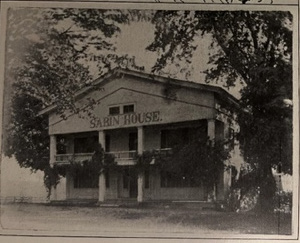
The Sabin House
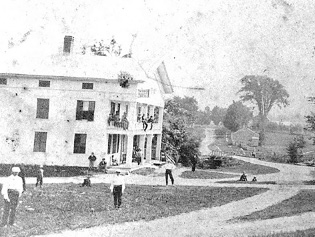
An early photograph at Five Corners
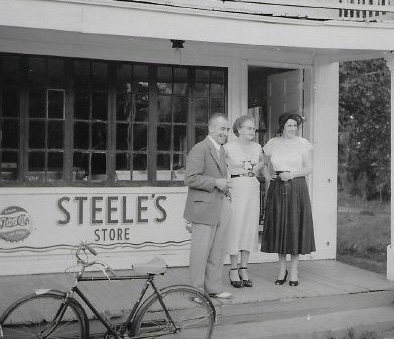
Steele’s Store
The Five Corners Historic District
The Five Corners Historic District encompasses the central district of the village of South Williamstown, Massachusetts. It is centered at the junction of Cold Spring, Green River, and New Ashford Roads. The junction has been a prominent center in the area since 1760. Notable buildings in the district include the South Center School, The Store at Five Corners, and the Second Congregational Church. The district was listed on the National Register of Historic Places in 1993.
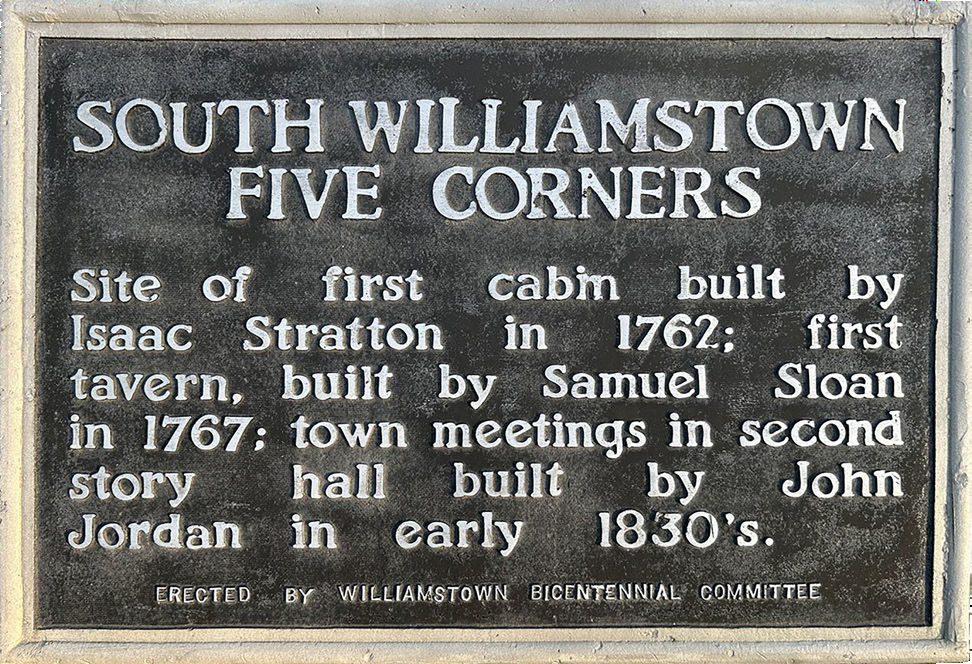
Notable Dates Related to the Five Corners Historic District
- 1745-48 West Hoosac surveyed
- 1750 Town lots established and sold
- 1754 Drawing by lot for land in South Part
- 1760-62 Isaac Stratton cleared land
- 1762 Bridge built so that Stratton and Burbank could attend church and town meetings
- 1765 Samuel Clark built saltbox on Sloan Rd
- 1767 Samuel Sloan bought tavern site
- 1769 Isaac Stratton gave land for cemetery
- 1770 Samuel Sloan built tavern
- 1775 Capt. Samuel Sloan led minute men to Charlestown and Battle of Bunker Hill
- 1777 Capt. Samuel Clark led company to Battle of Bennington
- 1790 William M. Young (descendents still living on part of land) purchased saltbox on Sloan Rd from S. Clark
- 1800 Town School Districts established
- 1805 North and South parts issued separate warrants for Town Meetings
- 1806 Ambrose Hall built his house
- 1807-08 First Schoolhouse constructed
- 1808 Second Congregational Church established
- 1808-13 Meeting house built
- 1842 Mills School / Greylock Institute founded
- 1865 South Center School built
- 1875 Present Second Congregational Church erected
List compiled by the History Committee of the South Williamstown Community Association.
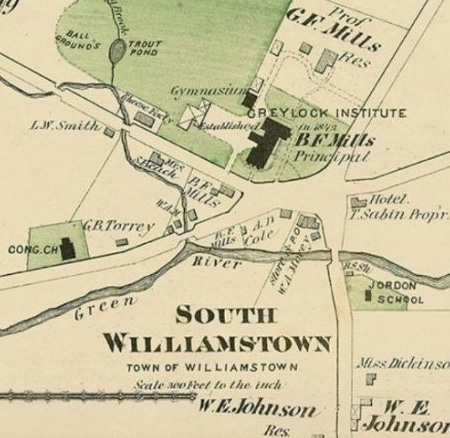
Map from County Atlas of Berkshire, Massachusetts. From actual Surveys by and under the Direction of F.W. Beers., R.T. White & Co., New York, 1876.
For more information about the Five Corners Historic District and Williamstown’s history, visit the Williamstown Historical Museum.
 Download a copy of our

Five-Corners-1880-300×175

Steel-1960s-300×186

IMG_6579 (1)
